City marketing: also think of street art on transformer houses and cabinets
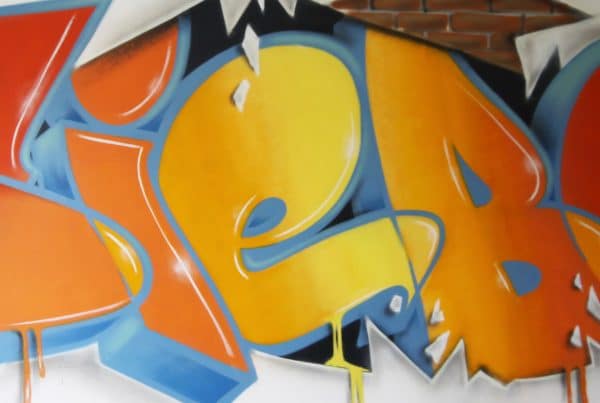
Street art is a comprehensive term. And what you can bring back to the street art is at least as comprehensive. The city of Heerlen is now quite well known that a few years ago they focused on having large murals made as a form of city marketing. However, the public space offers many more possibilities for the use of street art.
Transformer houses, electricity houses, pumping stations and waste containers in all shapes and sizes. They are objects that are often daubed and/or pasted, while these are objects that can beautify the neighborhood when a well-thought-out work of art is applied.
An electricity house without posters and graffiti
Until about ten years ago, transformer substations were very occasionally spray-painted or decorated on behalf of a municipality or energy supplier. Nowadays, street art is increasingly becoming part of city marketing plans. Both at home and abroad, you can follow a street art route in more and more cities, allowing visitors to view murals—large wall paintings—through various city districts. Alternatively, routes draw attention to small, usually not immediately visible, artistic interventions in the streetscape.
Beautifully decorated electrical substations can also be part of these street art routes . Untreated, these are often defaced or plastered with posters. Beautiful, decorated substations and cabinets have a preventative anti-graffiti effect, and far fewer posters are pasted over artwork. Much more often, they remain untouched, keeping the streetscape neater, tidier, and more beautiful.
Subsidized street art on transformer houses
Municipalities generally offer subsidy opportunities for street art. As a result, a proliferation of street art projects has emerged in cities. Huge sums of money are earned from this, but it often seems as though the execution is not well thought out. A resourceful 'guy' or local street art initiative devises a project, presents it to a municipal government, is awarded the subsidy, and then the execution takes place. Sometimes this is done by a third party, who is brought in and receives only a meager percentage of the actual subsidy amount.
It also happens that one or more artists are given the freedom to let loose on a transformer substation or cabinet. The result is a wide variety of styles and colors, without the client—who, incidentally, can also be an electricity grid operator—having any influence on the final result. To what extent this fits into the streetscape remains to be seen. As a professional graffiti agency , we believe that this can be done better and that the artworks should be tailored to, for example, the surroundings or history of the area, rather than to the style of a random artist.

Painted electricity house in Rijswijk.
Integrating electricity houses into the streetscape
In the Netherlands, there are approximately 100.000 transformer substations of various shapes and sizes. And the number is growing, as Amsterdam expects to double the number of transformer substations in the years leading up to 2050. With the right approach, these can often be beautifully integrated into their surroundings.
As indicated earlier in this article, our murals have an anti-graffiti effect. By having a beautiful mural created on an object plagued by graffiti, you therefore kill two birds with one stone. More about our anti-graffiti projects.
When we receive a request for, for example, a painting on an electrical box or house, we always look at the environment. And of course we discuss the expectations with the client. Decorating a house in a green environment with graphic surfaces, lots of bright colors and sharp lines is a shame. It doesn't fit, it actually detonates in the environment. While such a building can be integrated into the environment in a beautiful and subtle way.
For example, we painted an electricity substation in a park in Rijswijk. The brief included a request for a bookcase, but otherwise the execution was left open. Thanks to the use of plenty of fresh greenery, flowers, and animals, it no longer stands out as a transformer substation and actually adds something extra to the already green surroundings. At a football club in Zetten, we spray-painted electrical cabinets on the wall in the club's branding, making it fit the club and even turning it into an additional recognizable object.
-

- Anti-graffiti painting Prorail.
-

- Electricity cabinets as street art in Zetten.
The transformer house as a neighborhood participation project
Requests to spruce up a dull or even ugly electricity substation, pumping station, or waste container sometimes come from residents. In that case, the municipality or manager must naturally agree, as they are responsible for the structures. The municipality can also use having a transformer substation painted or sprayed as a neighborhood participation project.
In that case, people from the neighborhood can submit ideas. In our experience, this works well. Of course, the client can set conditions, such as the color scheme, the theme, or a specific subject. For example, if a cottage is located in a neighborhood where the street names are bird names, it is not a crazy idea to link that theme to the mural .
In Hoek van Holland, we painted a small electricity substation that was previously an eyesore for a resident who looked directly at it from her home. Now, the substation depicts the beach, sea, sky, and birds. The commission was ultimately awarded by the Municipality of Rotterdam, and local children were even able to help create the artwork. View this project in our extensive portfolio.
Another form of neighborhood participation is that we draw up the sketch and people from the neighborhood can fill in the details. Of course, what we do—street art, graffiti, paintings, murals, and much more—is a craft. So there is a limit to the contributions that are possible. Still, if the end result is beautiful and satisfactory, and neighborhood residents have gotten to know each other better through the project, that is a double win.
Natural images to camouflage a transformer house
As mentioned earlier, designs for a street art initiative subsidized by the municipality often go in all directions. This is because the artists hired for the project are often given carte blanche. Consequently, there are not many other possibilities in that case. You receive a design in the style of the chosen or assigned artist, and custom work is not possible. We do not like this and believe that the design—for example, for artwork on electricity substations —should be tailored to the wishes of the residents, the location, and the surroundings of the object.
A design must fit in with the environment and above all it must be in line with what the client wants. So we work differently. Graffitinetwerk is a company with professional artists and performers. This means that we make what the client wants. When a city, municipality or energy supplier places an order with us for painting transformer houses or cabinets, we come to something together. We almost always recommend natural elements. so that it artwork fits into the environment and that it doesn't get cluttered. This increases the quality of life in the neighborhood and the appearance of the district.
-

- Transformer house with a graffiti painting.
-

- Painting of Hoek van Holland electricity houses.
Preventing additions with container art?
We started this one blog with the comment that the public space offers so many more possibilities than just walls and electricity houses. Also consider art on garbage containers and waste containers. Municipalities struggle with people who place waste, glass or furniture next to the containers instead of in them, the so-called additions or adjacent waste. With art on the containers, they become a lot more attractive and the design can also ensure that less waste is placed next to the containers. In our portfolio you can see more projects with which we addition try to prevent.
Waste containers, transformer substations, electrical cabinets of all sizes mounted on exterior walls, or pumping stations in residential areas—these are all objects that are quite often defaced and/or covered with stickers. Yet, these are precisely the objects that could beautify the neighborhood. With our container art , among other things, we try to make the concrete or steel elements blend into the surroundings. This means camouflaging them beautifully and attractively with natural elements. In other words, concealing rather than accentuating. This makes the environment calmer.
Would you like to know more about street art on transformer houses and cabinets?
Do you have questions, comments, or suggestions, or would you like to discuss the possibilities directly and request a quote? Or would you like to commission a mural ? Then please contact one of our specialists without obligation. We are happy to brainstorm with you on how we can turn your electricity substation, transformer station, pumping station, or waste container into a fitting work of art.